


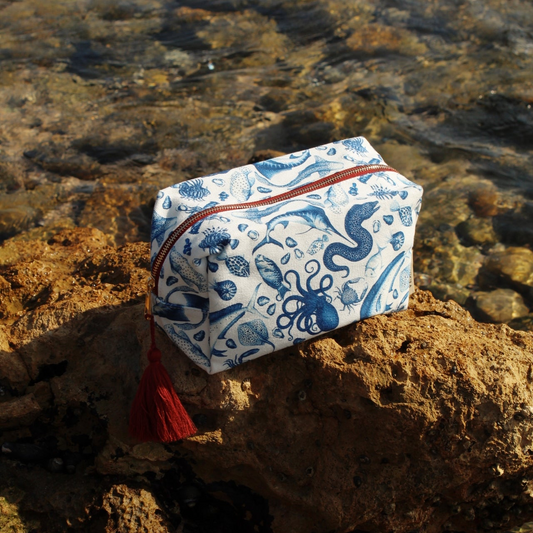
Specimens: Nautilus pompilius • Enteroctopus dofleini • Balistes vetula • Epinephelus striatus • Makaira nigricans • Ostracion cubicus • and more
-
Aquatic Affair Travel Bag
Regular price $58.00 USDRegular priceUnit price per

Field Notes · Hope Spots of the Atlantic & Pacific
A Field Guide to Aquatic Affair
Creatures spotted swimming through the collection - a few notes from the field.
Chambered Nautilus
Nautilus pompiliusA living fossil that has spiraled through the world’s oceans for over 500 million years, its chambers filling with gas to control its depth like a submarine.
Giant Pacific Octopus
Enteroctopus dofleiniNine brains, three hearts, and blue blood - the largest octopus species on Earth, able to squeeze through any opening larger than its beak.
Queen Triggerfish
Balistes vetulaPainted in improbable color and fiercely protective of its nest - even divers have learned to keep a respectful distance.
Nassau Grouper
Epinephelus striatusA master of disguise, shifting between a dozen color patterns in seconds to blend into coral, sand, or mood.
Blue Marlin
Makaira nigricansBuilt like a torpedo and armed with a spear-like bill, among the fastest and most powerful swimmers in the open ocean.
Yellow Boxfish
Ostracion cubicusEncased in a boxy shell of fused hexagonal plates - more suit of armor than fish.
Mahi Mahi
Coryphaena hippurusNamed "strong-strong" in Hawaiian, mahi mahi grow fast, up to 7 feet and 88 pounds.
Blue-Spotted Ray
Taeniura lymmaIts brilliant blue spots warn of a venomous tail spine, but this ray would rather bury itself in the sand than ever use it.
American Lobster
Homarus americanusIts shell turns red only once cooked - in the wild it stays a deep blue-green, and can live for over a century, growing larger with every molt.
Moonfish
Lampris guttatusAlso called the opah, it’s one of the only fully warm-blooded fish known, flapping its fins to keep its heart and brain warmer than the icy depths around it.
Common Shrimp
Crangon crangonNearly invisible against the seafloor, its translucent, sand-flecked shell shifts color over hours to match the ground beneath it, only revealing itself as it burrows away at low tide.
Ocellaris Clownfish
Amphiprion ocellarisCoated in a protective mucus that makes it immune to a sea anemone’s sting, it spends its entire life within a few feet of the same anemone it hatched near.
Dalmatian Grouper
Chromileptes altivelisCovered in black spots like a wetsuit-clad Dalmatian, with an unusually small head and steep forehead that give it an almost cartoonish profile.
Zebra Shark
Stegostoma tigrinumStriped as a pup and spotted as an adult, it spends its days resting motionless on the seafloor, using suction instead of speed to hunt buried mollusks and crustaceans.
Spotted Moray Eel
Gymnothorax moringaA nocturnal ambush hunter that breathes by opening and closing its mouth to pump water over its gills - a menacing look that has nothing to do with aggression.
Clown Triggerfish
Balistoides conspicillumPolka-dotted like storybook clownwear, it can shift rocks twice its own size to unearth the sea urchins and mollusks hiding beneath.
Lionfish
Pterois volitansFanned with venomous spines and no natural predators outside its native Indo-Pacific, it has become one of the ocean’s most successful - and unwelcome - invaders.
Red Spotted Crab
Carpilius maculatusAlso called the Seven-Eleven Crab for the eleven dark spots scattered across its shell, it carries a toxin potent enough to make it dangerous to eat.